
Disclosure: This article contains affiliate links. If you buy through them, we may earn a commission at no extra cost to you. This Mangools review reflects our genuine hands-on experience.
Mangools has built a reputation as the SEO tool for people who find Ahrefs and Semrush too expensive and too complicated. But does it actually hold up when you use it day to day? We spent time running real keyword research, rank tracking and backlink checks inside Mangools to find out. Here is our honest Mangools review for 2026.
Table of Contents
Quick verdict
Rating: 4.5 / 5. The short version of this Mangools review: it is the best value SEO suite for beginners, bloggers and small businesses. It bundles five well-designed tools into one affordable, genuinely easy-to-use subscription. It will not match the raw data depth of Ahrefs or Semrush, but for the price — and for anyone who wants results without a learning curve — it is hard to beat. Check the current Mangools pricing and free trial here.
Pros
- Genuinely beginner-friendly, clean interface
- Excellent, easy-to-read keyword difficulty scores
- Five tools in one affordable subscription
- Fast, reliable, and pleasant to use daily
- Great value versus Ahrefs and Semrush
Cons
- Smaller backlink and keyword index than Ahrefs/Semrush
- Lookup limits on the entry-level plan
- Not built for large agencies or enterprise needs
What is Mangools?
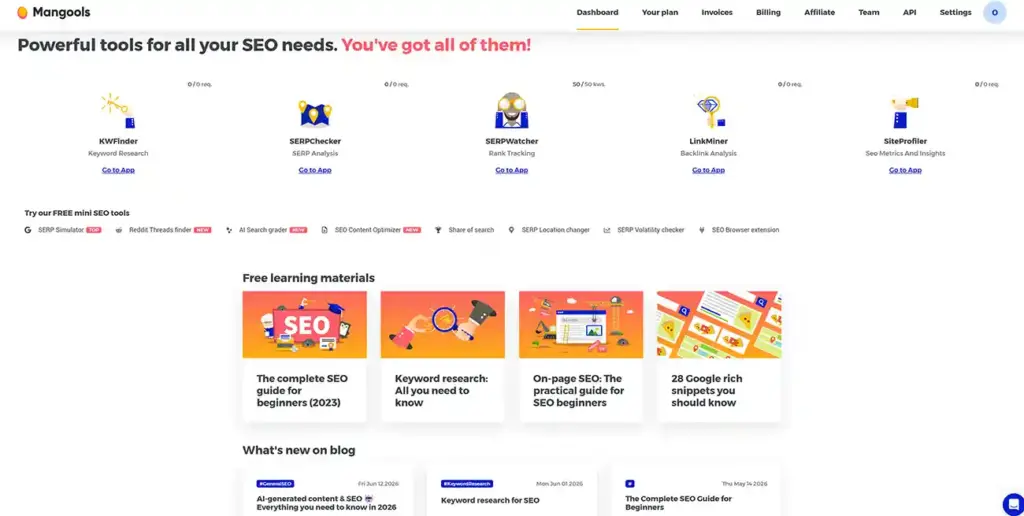
Mangools is an all-in-one SEO suite made up of five tools that share one login and one subscription:
- KWFinder — keyword research with search volume and difficulty
- SERPChecker — analyse the search results and your competitors
- SERPWatcher — track your keyword rankings over time
- LinkMiner — backlink analysis
- SiteProfiler — a quick SEO overview of any domain
There is also a handy free browser extension and a set of free tools. You can try KWFinder yourself here.
KWFinder: the star of the show
KWFinder is the reason most people buy Mangools, and it earns top billing. You type a seed keyword and get search volume, a colour-coded keyword difficulty score, trend data and a full list of related terms. Unlike free options such as Google Keyword Planner, which groups search volume into broad ranges and offers no difficulty metric, KWFinder gives you a precise, beginner-friendly difficulty score that you can act on immediately.
In our testing, KWFinder surfaced realistic low-competition keywords quickly and its difficulty scores lined up well with how hard those terms actually were to rank for. For day-to-day keyword research on a small site, it is all most people need.
SERPChecker and SERPWatcher
SERPChecker breaks down the top-ranking pages for any keyword, showing their authority metrics so you can judge whether you can compete. SERPWatcher then tracks your chosen keywords over time with a clean, motivating dashboard and a “Dominance Index” that summarises your overall progress. Neither is the deepest tool on the market, but both are clear and quick to use.
LinkMiner and SiteProfiler
LinkMiner handles backlink research — useful for seeing who links to competitors and finding link opportunities. This is the area where Mangools’ smaller index shows compared with Ahrefs, so if backlinks are your main focus, temper expectations. SiteProfiler rounds things out with an at-a-glance domain overview, handy for quickly sizing up a competitor.
Ease of use
This is where Mangools wins decisively. Every screen is clean, colourful and labelled in plain language. There is no overwhelming wall of metrics, no steep learning curve. If you have ever opened Ahrefs or Semrush and felt lost, Mangools is the antidote — you can do useful keyword research within minutes of signing up.
Mangools pricing
Mangools uses tiered pricing, cheapest when billed annually. Plans roughly break down as an entry tier from around $29/month, a premium tier around $44/month, and an agency tier around $89/month — each increasing your daily lookups and tracked keywords. There is a free trial and a money-back guarantee, so you can test it risk-free. Always confirm the latest numbers on the official Mangools pricing page.
Compared with Ahrefs and Semrush — both well over $100/month — Mangools is a fraction of the cost, which is the core of its appeal. For more budget options, see our guide to cheap SEO tools.
Mangools vs Ahrefs and Semrush
Be honest with yourself about what you need. Ahrefs and Semrush have larger data sets, more advanced features and deeper backlink indexes — they are built for professionals and agencies. Mangools trades some of that depth for simplicity and a much lower price. For beginners, bloggers and small businesses, that trade is well worth it. For an in-depth comparison, read Mangools vs Ahrefs and our roundup of the best Ahrefs alternatives.
Who should use Mangools?
As this Mangools review has shown, the tool is ideal if you are a beginner learning SEO, a blogger or content creator doing regular keyword research, or a small business owner who wants results without hiring a specialist. It is not the right pick for large agencies that need enterprise-grade data and integrations.
Verdict: is Mangools worth it?
To wrap up this Mangools review: yes, for the right user, Mangools is absolutely worth it. It delivers the SEO jobs a small site actually needs in an interface anyone can use, at a price that does not sting. It is our top pick for the best SEO tools for small business. If that sounds like you, start your Mangools trial here.
Frequently asked questions
Is Mangools better than Semrush?
For raw data depth and advanced features, Semrush is more powerful. For ease of use and value, Mangools wins — it is far cheaper and far simpler, which makes it the better choice for most beginners and small businesses.
How much does Mangools cost?
Plans start at around $29/month billed annually, rising to roughly $44 and $89/month for higher tiers with more lookups. There is a free trial and a money-back guarantee.
Is Mangools free?
Mangools offers a free browser extension and a set of free SEO tools, plus a free trial of the full suite. Ongoing full access requires a paid plan.
Is Mangools accurate?
In our testing its keyword volume and difficulty data were reliable for everyday research. Its backlink index is smaller than Ahrefs’, so for heavy backlink analysis a larger tool is better.
Related reading on NexusDrop: